|

Guide to ACWA
Amalgamated Clothing Workers of America Vintage Clothing Tags
|
|
|
The following information is a guide to identifying and dating vintage clothing, suits, coats, pants, jackets, and workwear that was sewn by the Amalgamated Clothing Workers of America based on the union label that is present on the garment. There are five different known union tags that were used to identify ACWA as the clothing manufacturer. Each of these tags was associated with a specific time period that identifies when the earliest time the item could have been manufactured. Please keep in mind that these dates represent the earliest time when the clothing could have been manufactured not the time when these item was sold. This is especially important when dating vintage suits, because often vintage suits would have the alteration alteration date marked on a separate tag within the suit. The date on the alteration tag can only be after the date of the ACWA tag and any garment that is not so can not be an authentic vintage garment. Additionally, manufactures used all issued labels before starting the next issued series.
|
|
|
| Years |
ACWA Union Vintage Clothing Label Description |
ACWA Union Label Photo |
| 1914 - 1933 |
It is not certain but believed that prior to joining the AFL in 1933, The Amalgamated Clothing Workers of America were not required to include a label with items that were manufactured by ACWA. If anyone can send proof to the contrary please contact us. |
Photo of Label is Not Applicable |
| 1934 - 1936 |
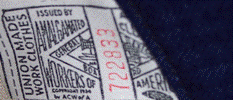
In 1933, ACWA started to include a union label in all garments that were produced. The vintage tag shown to the left illustrates the union's sewing machine symbol and scissors in the center of a diamond with red numbering across the center of this tag. The left side of the tag will read " Union Made" on the first line and either "Work Clothes", "Suit", or "Garment" on the second line. The lower left corner of the tag underneath the "Workers of" will read copyright 1934 by ACW of A. |
 |
| 1936-1939 |
Tags identical to the 1934 tag have been found with copyright date of 1936. This tag was used from 1936 to 1939. |
Photo not currently Available |
| 1939 - 1949 |
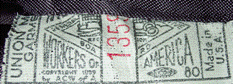
In 1939 a new tag was issued. The 1939 vintage label is identical to the 1934 issued tag. It has all the same features listed above except a new copyright date of 1939 followed by ACW of A. The right side of the tag will have the union bug mark followed by an number 80. |
 |
| 1949 - 1962 |
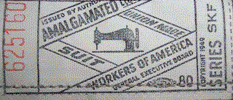
In 1949 the union label tag was redesigned. This vintage clothing tags of this type illustrate a sewing machine in the center, without scissors and a new layout for the Amalgamated Clothing Workers of America text. The red numbering will be on left of the tag and a "copyright 1949" will be on the right of the tag followed by a series code consisting of 3 letters. The lower left corner will not contain a circled R. |
 |
| 1962- 1976 |
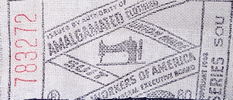
In 1962 the circled R trademark symbol was added to the lower left corner of the tag. These tags will stil have the copyright date of 1949 on the right hand side. In later years, the numbering on the left was changed to black instead of red. |
 |
|
History of ACWA
|
|
|
|
The Amalgamated Clothing Workers of America was formed in 1914 as a direct result of a bitter union strike in 1910 involving members of the AFL affiliated United Garment Workers (UGW), the AFL leadership, and their employer, Hart Schaffner and Marx. The strike expanded to city wide, 45,000 member garment workers strike in Chicago resulting in a division in the UGW membership. The union membership feeling that the union leadership did not reach a fair settlement on rejected the offer and continued striking. By 1914 the membership was ready for change and at the 1914 UGW convention 66 percent of the UGA membership defected to form Amalgamated Clothing Workers of America or ACWA. Shortly afterward, Sidney Hillman became president of the newly formed union and led it's membership for the first 30 years. As a result of this split, at its inception the AFL refused to recognize the ACWA as an AFL affiliate. Through a series of strikes in the late 1910's, ACWA continued to solidify its membership in garment industry and eventually established a stronghold in the key cities of Chicago, Baltimore, and Rochester, New York.
By the 1920's, ACWA was the largest men's clothing union in the United States and was responsible for manufacturing a staggering 85% of men's garment. Like all unions of the time, the great depression thinned the ranks of ACWA's membership. ACWA survived the downturn and much of it's membership returned thanks to the union's legal right to organize gained from the National Recovery Act of 1933. As a result, despite the 19 years of opposition with the AFL, ACWA finally gained the AFL recognition as an affiliate in 1933.
In 1935, while still leading the Amalgamated Clothing Workers of America and a member of the AFL, Sidney Hillman founded the Committee of Industrial Organizing (CIO) with the leaders of seven other AFL affiliate unions. At it's inception the CIO was not a rival of the AFL, but a part of the AFL that was focused on organizing labor in the mass production industries along industrial lines rather the by craft, skill, or trade. Other AFL leaders were opposed to organizing labor in this manner and in September, 1936 the eight founding unions including the Amalgamated Clothing Workers of America and two additional affiliates that joined the CIO were suspended from the AFL. In 1938 the CIO renamed itself the Congress of Industrial Organization and officially formed as a rival to the AFL. While other garment related unions such as ILGWU and the Millinery Workers returned to the AFL at this time, ACWA remained committed to the CIO until 1955 when the AFL and CIO finally merged back together forming the AFL-CIO.
The Amalgamated Clothing Workers of America continued to grow through the 1950's and remained a dominant union in the manufacturer of men' suit through the 1960's and early 1970's. In 1976 it ended 62 year of organizing labor under the name Amalgamated Clothing Workers of America when it merged with the Textile Workers of America and formed a new union known as the Amalgamated Clothing and Textile Workers Union (ACTWU).
|
|
|
|
|
|